


Syllabus: GS3/ Economy
Context
- The Reserve Bank of India looks set to allow fresh licences for Urban Co-operative Banks (UCBs) after the pause began in 2004.
What the Proposal Involves?
- Minimum Capital Requirement: RBI has suggested a minimum capital requirement of Rs 300 crore for new entrants, a bar considerably higher than what earlier UCBs were expected to meet.
- Eligibility Route: Rather than allowing entirely new banks to be set up from scratch, the preferred route is conversion, where large and well run cooperative credit societies graduate into full UCBs.
- Financial Health Criteria: Only financially sound entities, those keeping Net NPAs below 3 percent, be allowed in.
- Support Ecosystem: To ease this transition, RBI has also set up an Umbrella Organisation that can support the sector with capital, technology and shared expertise.
What are UCBs?
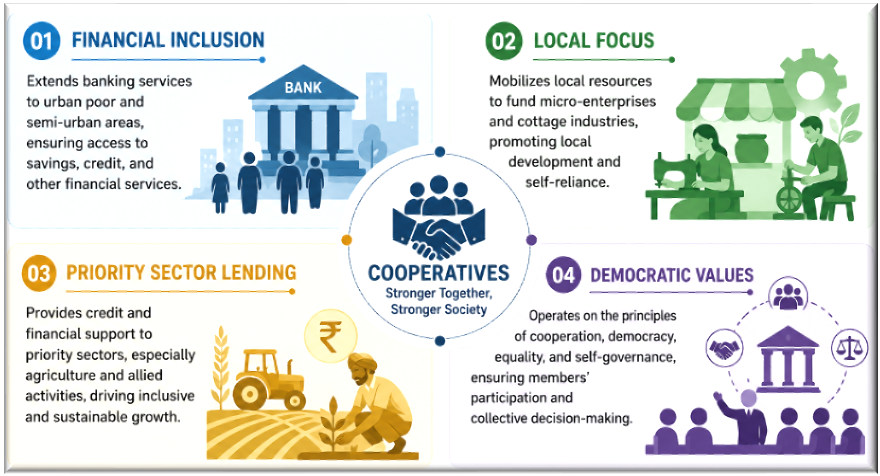
- UCBs are member-owned, democratically governed banks serving urban and semi-urban areas small traders, salaried workers, and MSMEs who are too small for commercial banks yet too formal for moneylenders.
- They work on cooperative principles of mutual help & one member one vote.
- Dual control: RBI (banking) + State Registrar of Cooperatives (membership, elections).
Significance
- Financial Inclusion: UCBs have traditionally been the first point of contact for small traders, self employed individuals and households who commercial banks often overlook, so a well designed expansion could meaningfully deepen financial inclusion.
- Sectoral Consolidation: As of March 2025, the cooperative banking sector comprised 1,457 banks holding assets worth Rs 7.38 lakh crore, yet the distribution within this universe is heavily skewed.
- Just 7 percent of UCBs hold deposits above Rs 1,000 crore, but together they account for 62.5 percent of total deposits, while more than half the UCBs, holding under Rs 100 crore each, contribute barely 5.6 percent.
- Regulatory Confidence: Two decades of tiered regulation, stronger supervision and governance reform have improved sector resilience, giving RBI comfort to reopen licensing.
- Vote for Cooperative Model: Reopening licensing signals institutional confidence in the cooperative banking structure despite past failures.
Challenges and Concerns
- High Entry Barriers: Industry stakeholders argue that the Rs 300 crore capital norm will exclude most genuine cooperative societies, defeating the inclusion objective.
- Dual Control Structure: UCBs continue to face overlapping jurisdiction between RBI and state Registrars of Cooperative Societies under respective Cooperative Societies Acts, complicating supervision and compliance.
- Technological Deficit: Many existing cooperative institutions lack the digital infrastructure needed to meet modern banking and compliance standards.
Way Ahead
- Ministry RBI Coordination: A joint framework between the Ministry of Cooperation and RBI can align the inclusion mandate with prudential safeguards, avoiding contradictory signals to the sector.
- Strengthening Umbrella Organisation: Scaling up the Umbrella Organisation’s role in providing liquidity support, technology and capacity building can help smaller societies meet eligibility norms over time.
- Extending Deposit Insurance: Bringing more cooperative credit societies under DICGC style protection, even outside full RBI licensing, can safeguard depositor interests in the interim.
Source: TH
Previous article
Drone-Based Transportation of Tea Leaves in Kerala
Next article
National Investment Policy for Urea (NIPU)-2026
